It might come as a surprise at the tender age of 26 (!!!!) that i am concerning myself with the small matter of age.  Being in a profession where a healthy body is the end goal, it is common sense to look at natural ways to prevent wear and tear.  I am not talking just about muscles and bones, the internal workings of the body are equally as important.  I believe we are becoming more aware of our bodies, and are taking up sports like pilates, yoga and swimming alongside the cardio forms of exercise like running and cycling.  This is positive but only the tip of the iceburg.  There are a multitude of small things we can do to prevent dis-ease from happening and it all starts with planting that first seed of change or "preventative medicine".

What happens with Age?


"It's not how old you are, it's how you are old" - Jules Renard

Cells deteriorate

  • These are the basic building blocks of all tissues  in the body (muscles, etc)
  • Connective tissue becomes stiff, making organs, blood vessels and airways more rigid so not so efficient
  • The speed of deterioration or how long a person lives is a balance between how fast things go wrong and how efficiently the body functions to prevent damage build up

Nervous System

  • Nerve cells transmit messages more slowly
  • As nerve cells break down, senses may be lost such as sight or hearing
  • Reflexes may be lost causing imbalances
  • Slowing of thought, memory and thinking

Metabolism

  • This is the sum of all chemical reactions taking place in the body (energy is required for the brain, heart, lungs and other organs to function and for activities like eating, walking)
  • Metabolism usually declines 2-3% with every 10 years in adults mainly due to  an increase in body fat

Changes to the Skeleton

  • Osteoporosis where the bones become thinner as a result of a decline in bone tissue renewal
  • These thinner bones are more vulnerable to breaking
  • Osteoarthritis where the cartilage that lines the joints gradually degenerates with wear and tear (such as the knee)

Organ Function

  • Heart, lungs, kidney, liver and brain are all affected
  • The rate of ageing varies from one person to the next
  • Often one organ becomes the “weakest link”
  • Those that live into their 100s do not have a weak link!

Our DNA

  • Genes (or our blueprint) are passed down from one generation to another so we may look like our parents or grandparents
  • As we age, WE do not necessarily inherit the diseases our parents had because every cell in the human body has a membrane which contains 100s of 1000s of protein receptor switches that act like revolving doors deciding whether to let in or let out molecules e.g. those that trigger cancer
  • What causes the turn of the switch is an environmental signal – from the air, water and food we consume, the toxins we are exposed to, and even the people we surround ourselves with


How can we Age Gracefully?

There is no magic pill or miracle cure (sorry sis) but there is buckets we can do to keep our bodies and minds healthy.  Some of this you will know, most of it will seem like common sense and hopefully all of you will do one of the list below to make a  positive change to lead to a healthier and happier tomorrow.


Eating well


  • Let food be your medicine. 
  • Cook from scratch, that way you know what is in the food you are consuming (jamie oliver has some brilliant 30min dishes online)
  • Avoid processed food and the sweet stuff – it tastes good but plays no part in the functioning of the human body.
  • Supplements  - required more nowadays with the fast food fads that have no nutritional value.  Take them in the liquid form as absorbed quicker and act faster.
  • Vitamin B – all B’s are good for the nervous system and most people experience stress at some stage in their life. 

Drinking good quality water

Filtered or bottled water is better than tap water, unless you live in the Scottish highlands!


Breathing fresh air

  • Get into green spaces if you work in the city to soak up less polluted air
  • Breathing properly is possibly the most important thing you can do in this life time to de-stress, massage your internal organs, improve your thinking capacity, improve your physical stamina and relieve pain.  Without our breath, we would not survive.  It is something that requires practice as we do it all day long and often incorrectly.


Living a fulfilled Life

  • Ensuring you have a happy home is at the heart of good health
  • Recognising any work/relationship/home life stress and dealing with it
  • Every thought and emotion produces either a stress or healing response in the body which is why people bang on about meditation and why physical therapies provide clues to where there are “imbalances” in our lives.
  • Life is for living not enduring so stop and listen to your body and respond to its needs


Self-healing

  • Giving yourself a daily 30mins to focus on you, your breath or an exercise routine can work wonders.  This includes parents too!
  • Stretching, mobilising joints and strengthening your core is key to walking tall and fluidly
  • Stiff, rigid bodies break easier than malleable flexible ones
  • Taking glucosamine with chondroitin daily or Vegepa (pure omega 3/6) helps joints as do oily fish
  • Prickle balls and tennis balls are fantastic tools to trigger point any tension in muscles
  • Use nature's finest products for everything: from skin care, to hair care, cleaning products, and make up.  It is amazing how many people are allergic to chemicals  in everyday products.

Resources:
  1. Nutritionist:  Julia Charles www. nutritionfornow.co.uk
  2. Liquid vitamins:  www.nutricentre.com
  3. Helene Deville Moisturiser, tonic, face peel and spot cream:  Vanessa!
  4. Prickle balls:www.amazon.co.uk
  5. Foam/stability rollers:  www.physicalcompany.co.uk

Books
  1. Look Great Naturally- Janey Lee Grace
  2. Imperfectly Natural baby and Toddler - Janey Lee Grace
  3. Imperfectly Natural Woman -  Janey Lee Grace

Please contact Vanessa on 01491 577480 to book a massage treatment if you want to make one positive change today!
What is life without challenges and hurdles?  Perhaps a little monotonous and less informative.  I am learning to do what i have preached for years after a back problem left me unable to work for a month. 

The Discovery
Pain comes in all forms and sizes but the most important thing is not to ignore it as i did. I had a dull ache back in September in my lower back, and found it really uncomfortable driving back from a break in Cornwall in October.  It felt like needles in my left buttock.  I put it down to doing too much and not stretching enough.  I took up yoga for the first time in years.  Every downward dog was so uncomfortable but i ploughed onwards, thinking it could only be doing me good.  I was in a gentle class for those recovering from injury so what harm could i possibly be doing??!  I was seeing my regular osteopath rather more regularly than usual and still the pain was there and i was beginning to find it tiresome.  I reached the stage after 3 months where the only relief i got was from rolling a tennis ball against the wall down each side of my spine on a daily basis.  By Christmas Day i was sitting on a pilates ball in a back brace on pain killers.  The point is, i left it too late and by ignoring the warning signs became immobile and off work.

Diagnosis
My two worst positions were bending forwards and sitting, so that ruled out driving, catching a train or bus, eating at a table, putting on socks from standing and massaging.  My osteopath had instructed me to see a GP for an MRI as he suspected a prolapsed disc or an annular disc tear.  A normal X-ray would not show up this kind of soft tissue damage as is only really useful for bone related issues. Yup - it sounded rather alarming to me too.  My first point of call was the GP to get a referral for an MRI scan to find out what i was dealing with.  Sounds simple enough?  The first two doctors i saw prescribed painkillers.   The second referred me to a muscle hub in January as they are trying to reduce unnecessary MRI referrals as they cost the NHS money.  I have yet to see anyone (it is now March).  I took the bull by the horns as i needed answers before a flight in February, so went down the private route.  Vista Diagnostics is a brilliant centre in Waterloo, London.  With a referral from a physiotherapist, chiropractor or osteopath, you can contact this company and make a next day appointment and walk out with your MRI on a CD that day.  It is not as expensive as you might imagine.  £250 bought me peace of mind.  Well, kind of as once my osteopath had viewed the images, the prolapsed disc was a reality. Let me explain what a prolapse means.  It is often called a herniated or slipped disc although the name is irrelevant, it is what is happening in the spine that matters.

Prolapsed Disc/Slipped Disc/Herniated Disc


Many people have undiagnosed prolapsed discs and will never worry about them as there is no pain involved.  A diagnosis only becomes necessary when pain is involved as carrying on with day to day life is hard when you have a niggling sensation 24/7.  A prolapse is most common in men and between the ages of 30-50.  After 50, the jelly like texture of the nucleus in the disc dries up so there is no longer the risk of nerve pain.  A disc as you can see in the image above is the soft cushion between the bony vertebra of your spine.  They lie between every single vertebra in your back so in theory any could prolapse but it is usually your lower back or sometimes your neck that suffer.  They have a poor blood supply hence the slow recovery rate when one is damaged.  There are a plethora of reasons for why it happens but the general gist is, overuse (bending forwards repetitively in a job, sitting hours at a desk, lifting heavy weights etc), posture, inherited weakness or sneezing!  What actually happens is the disc tears from the centre outwards and produces a bulge which may or may not prolapse.  As the diagram shows the contents of the nucleus in the disc seeps out of the tear and surrounds a nerve which causes shooting pain down the buttock and leg.  In more serious cases, bladder and bowel function can be compromised if the nerves at the base of the spine are pressed on.  Instant GP appointment required in this case.  I fortunately avoided this but as my osteopath told me my prolapse was as severe as they come and he was surprised i was coping without painkillers and functioning.  A GP who looked at the scan would have had me straight onto the operating table.

What enables me to cope with back pain?

Hands on Therapy!!! (massage, acupuncture, osteopathy)
The moment i was sat on that pilates ball on Christmas day in a back brace i knew i was going to need help.  The pain of getting out of a car and sitting down even on a pilates ball was excruciating.  I was not sleeping well as lying on my side was uncomfortable even with pillows between legs.  You become tired, and less able to deal with the pain.  It is a difficult place to be.  That Christmas week alone i saw 4 practitioners for treatment to take some tension out of my muscles which had clamped around the disc to protect it.  I am lucky knowing top rate practitioners in the first place but i still had to pay for every treatment.  I soon realised that money was going to have to be spent to cure this problem and time.  Acupuncture was great at relieving the buttock and back muscles and calming the mind aiding the body to deal with the neural pain.  I could take deep tissue techniques from day 1 as the muscles responded well to the pressure and the relief was immense.  Listen to your body and what it can take as only you have the answers.  Sports massage was effective and i saw an osteopath to occasionally manipulate the discs around the problem disc.  It was gentle and effective. I have continued to have treatment once a week (now 2 months into the rehab).
Trace Elements
These I take periodically when the body is "blocked" in some way.  In other words, when i am catching lots of colds showing my immune system is not functioning well or when i have had an injury and am experiencing nerve pain.  It is a coincidence that i was already taking a product called No7 which treats the nervous system.   I added protogel to this which helps heal connective tissue and cartilage, necessary for my disc recovery.  A disc consists of several layers of fibrocartilage. I am a firm believer that this alone has aided my ability to tolerate the nerve pain without medication.  Trace elements represent 0.01% of our body.  They act as catalysts allowing an action in the cell of the body to happen with less time and energy.  Trace elements are more important today as there are more reasons for the cells in the body not to function positively because of:
  • medication
  • pollution
  • poor nutrition
  • electro magnetic waves
  • emotional problems
  • rhythm of life - sleep/work/relaxation not in balance
Unlike herbal medicine, it does not go through the digestive system to be broken down which takes time and can produce side effects.  It is taken under the tongue and straight into the system so results are relatively quick.
Pilates Exercises and Stretches
For the next month i had a weekly one to one pilates class with the amazing Sue Lloyd who i knew already.  I remember trudging through the snow to reach her house on the fair mile as my warm up.  It hurt to walk too but i knew i needed to stay mobile.  In these classes i learnt how far i could stretch my muscles and the importance of regular stretching and exercise.  Impressively without a diagnosis until February, i was able to stretch my hamstrings lying on my back and do pretty much everything except stretching my gluts on my left side (prolapse was to the left) and my left adductors.
Mindful Exercises and Breathing

In order to deal with the lack of sleep which had become chronic, i saw a Sleep Doctor.  They exist!  A young man called Guy Meadows who works in London is a physiologist who has studied sleep over 4 years and has a PHD in sleep.  The basis of his work is a drug free way of dealing with sleep problems and minimising pain.  In essence, you imagine your pain in lots of detail...its colour, size, where it is in the body and how it makes you feel and as you acknowledge it, it becomes less difficult to handle.  You take the image you have in your mind and place it somewhere else in your body.  It is an acceptance of the pain rather than struggling with trying to control it.  A simple and effective technique which practised daily does work.  Likewise, observing the breath and in so doing, calming the mind helps with pain.
Chair Support
A therapist friend suggested using a wedge to sit on which causes you to sit at such an angle that there is no pressure on the spine.  I have taken it everywhere.  It comes with me in taxis, at restaurants, in churches - you name it.  I have even named it my clutch as it is black and square like and at night time perched under my arm looks like a bag rather than a cushion!!!
Ice and Heat
Instead of painkillers or inflammatories i have spent 20mins every day on an ice pack.  It is the time of day when the back is struggling and really does give me enormous relief.  I used to have a warm bath too every evening but in time the back becomes stronger and it does not feel essential anymore.
Rest
I do less nowadays.  I stopped hiking at weekends and my exercise is pilates style core strength exercises, work, walking 30mins every day and resting in between.

Everyone is unique.   I hope to be sitting comfortably by the summer so roughly a year after first feeling pain in the buttock.  Listen to your body and respond early when it calls out for some attention.  For any information, or to book an appointment with me, call 01491 577480.

Resources:
Osteopath:  Bradley Whale 07727692224
Pilates Teacher:  Sue Lloyd 07901590948
Seat Wedge:  http://www.sittingwell.co.uk/products.asp?categoryID=10836
Back Pain Exercises App:  http://shop.feelingprettyremarkable.com/
Sleep Doctor:  Dr Guy Meadows http://thesleepschool.org/
Trace Elements:  Vanessa Mansergh 01491 577480
Vista Diagnostics:  0845 4503559 (a referral is essential)

Native American Indian Stone Medicine


In many of these blogs i have written i have described the benefits of temperature in a hot and cold stone massage, as everyone is familiar with heat and cold.  What i have not described in any detail is the native american traditions and culture that rest behind the temperature treatment.  It is a vast subject, so i will attempt to bring some of the most subtle expressions of their beliefs and practices in my mind.

Inyan Pejuta

Inyan is a Lakota word meaning Stone and Pejuta Medicine.  American indians believe that the physician within is the true healer.  So Pejuta describes a way of healing the spirit through various treatments, ceremonies or herbs.  Pejuta winan or medicine woman and Pejuta wichasha or medicine man are not considered western medical professionals like doctors or physicians.  They are healers who work with Creator to help bring wellness (physical, emotional and spiritual balance) to the individual. 

Shaman

A shaman can be a medicine woman or man but not all medicine workers are considered shamans.  Shamanism is an ancient and primitive method of healing that is used by nearly all indigineous people in the world.  At its core is the belief that our Creator has provided us with all medicines through Mother Earth.  There are many different forms that are passed down from one generation to the next with only that particular lineage being able to carry on the teachings.

Stone Walker

Stones have been part of native american culture for 1000s of years.  Stones are used in Inipi Ceremony or sweat lodge where they assist in the healing process on a spiritual level while cleansing the body of toxins on a physical level.  Though an ancient practice, it is a very current one too with saunas.  The american indians believed the stones recorded the history of Mother Earth (fossils) and archeologists have proved this to be true.  Gem stones are used today to ornate the body as jewellery but they also offer energetic and healing properties.  Getting back to the term stone walker.  This is a a way of describing the practitioner who moves stones from one place to another during a treatment.  It is more humble than saying shaman or healer as these titles require years of apprenticeship.

Mother Earth

Native americans are taught that we are one with all things in creation.  Mitakuye Oyasin means literally all relations which is translated as we are related to the Earth and all its creatures.  Everything Creator has made carries an energy that comes from God, also known as Great Mystery, White Buffalo Calf Woman for the wisdom and medicines she gives, Grandfather for the way we are cared for or Great Spirit.  As they believe that as humans we are related to everything, we are no more important than the trees, the birds, the fish, the animals, the insects and the rocks.  This allows for humility and believing that the practitioners of stone medicine are simply the feet that walk the stones on the body.  This belief system comes from Mother Earth's teachings.  When a hawk flies over head from the East, it signifies change.  If the hawk settles on a post nearby, it means staying put to deal with a situation.  They listen to the sounds of nature and resonate with them.  Their flutes can sing high pitched bird songs or howl deep tones like the wolf.  From the distance of a mountain top, human voices in a village below sing the same song as a great migration of geese.  This is all about living in harmony with Mother Earth.  Modern noise pollution has made it harder to hear the sounds of Mother Earth.  Living in cities, away from the land, eating food with artificial chemicals in and rushing from buildings to cars to offices means many are out of touch with Mother Earth.

Smudge Ceremony

The lakota word is wazilyA which means to create smoke from herbs and draw it over the body during rituals and ceremonies.  It is a ceremony for cleansing, much like incense is used in European churches and Eastern cultures.  The herbs used are sweet grass, sage, cedar, palo santos and other mixtures depending on the tribe and what is available in that region.  Traditionally the herb is placed in an abalone shell, clay bowl or stone vessel and the smoke is directed with the hands, a feather or prayer fan towards the body.  An entire ritual is performed starting at the top of the head and ending at the feet.  Much reverence is given to each part of the body.  The smudging clears away any negative visions at the eyes, asking to see with love, it helps remove the sounds of war, anger, disrespect and fear from the ears, hearing instead what the Great Creator is telling us, it cleanses our thoughts, our minds, and our hearts from stress, animosity and petty grudges.  When it reaches the feet, there are prayers for freedom from burdens too heavy to carry and that we may walk straight on the life path Creator made for us.  The ceremony is always offered with respect and dignity for these good intentions.

Calling Directions

By bringing the energies of the 4 directions:  North, South, East and West, a Sacred Space or Holy Ground is created for ceremonies to be performed. 
East (yellow):  represents the rising sun and signifies new beginnings, change and renewal.  Every morning we forgive ourselves and are reminded that present moment is all that exists.  Symbols include seeds as Spring is the season, air, and the power animals:  eagle, spider, fox and crane.
South (red):  represents the full summer, growth  whether spiritual, physical or mental and abundance.  It takes patience and faith to grow.  Symbols include candles as Summer is the season, fire and the power animals:  coyote, wolf, black panther, gecko and puma.
West (black):  represents the night and is a place of rest, visions and dreams.  Visioning is very important in the native american culture.  Symbols include:  the spiral, earth, Autumn is the season and the power animals:  raven, hawk, owl and bear.
North (white):  represents the winter snow, hibernation and health by slowing down to conserve heat, body fluids and energy  Symbols include mountains, water, Winter is the season and the power animals:  white buffalo, white bear, wolf, reindeer and moose.

These are just a few aspects of the native american indian stone medicine.  I hope it has given you some food for thought in our slightly crazy and frenetic lives we lead!  It only take a minute to stop, and refocus and now is the season for it.

If you would like to book a treatment with Vanessa, either email her at vmansergh@hotmail.com or call on 01491 577480 or 07906186912.
Homeostasis is the stable environment our bodies strive to maintain by constantly adjusting. Its regulation is controlled by the nervous and endocrine systems. The name homeostasis was created by the physiologist Walter Cannon in the 1900s and literally means "balance or equilibrium". The homeostasis process involves 3 main components: the receptor, the control centre and the effector. The receptor picks up data or signals called stimuli which are sent to the brain, the control centre, and the decisions are made.

Let us take the introduction of temperature to the body as an example. Many systems of the body are dedicated to making sure the body remains at its core temperature of 37.7 Celsius. When the balance or homeostasis is disturbed, the body gets to work to correct itself. A good analogy to explain this is War. When soldiers are waiting to go to War or to bring peace, or balance where there has been a disturbance, they hang out in the barracks waiting for direction from the Commander. The body works in the same way. Your brain is the Commander-in-Chief giving orders to all the soldiers that live within the body. These are the enzyme soldiers, immune soldiers, and the blood soldiers to name a few. We are focusing on the blood soldiers. The brain and body are also equipped with runners or informants who are in constant communication with the Commander, reporting the condition on the body.

During a hot and cold stone massage, the hot stones at 50-55 c are introduced to the body first by using the usual warming massage techniques. These stones do not pose a big threat or an attack to the core temperature of 37.7c, although a slight change occurs in the resting temperature. So the informants run to the Commander in a split second and report the change to the periphery of the skin's surface. A few of the blood soldiers are needed. The Commander orders the blood vessels to widen slightly, allowing these blood soldiers to the area. This explains why the skin becomes slightly red and warmer. The Commander even donates some of his own blood soldiers so a slight sedation takes place and the body feels cosy, warm and relaxed.

A cold stone is then introduced to the body which is 40-50c cooler than the hot stone which warrants many more blood soldiers to bring back that homeostasis or balance. The informant in a flash dashes to the Commander and screams "ATTACK!". There is a huge disturbance to all the systems of the body. All the blood soldiers are forced away from the front line - the skin. This is called vasoconstriction. The Commander sends all the troops to the area under attack. Those troops hanging out in the barracks - the kidney, liver, the heart, the lung and all the other vital organs are all sent to the area. They rush there bringing lots of blood - warming and clearing out all organ and muscle tissue in their path. This explains why a cold application creates heat and why hot and cold combined cleanse the vital organ system making It stronger and boosting the immune system.

Homeostasis is important for everyone and is critical to athletic performance. So this year when our athlete's perform in the Olympics, spare a thought for the rigours their bodies will be under! What is key for them is the balanced mechanical function (on top of optimum cardiovascular, respiratory and metabolic function) of the musculoskeletal system. Humans can only experience optimal movement, whether running, cycling or swimming when all the muscles and joints are in harmonious coordination without the expense of compensatory mechanisms. This means that having low back pain makes the athlete run slower and consume more energy with every motion. Their reaction times are slower, they fatigue easily and are more vulnerable to injury and post exercise recovery may be delayed.


If you would like to book a hot and cold stone treatment, please contact Vanessa on 01491 577480 or 07906186912.


Never in my wildest dreams would i have envisaged seeing snow capped mountains on a beautiful sunny day for 6 days on the trot.


The last time i was in Nepal- i spent a month staring at what appeared to be a mountain range covered in a layer of mist. Only once did i glimpse the "fishtail" mountain - Machhapuchhre (on the left).


I guess i should start at the beginning...my friends and i started our adventure from Heathrow. We did not meet up officially with our group & guide from Explore until Kathmandu but we were positive we would be spotting others way before then. What we didn't expect was every other person on our flight to be wearing trekking boots & ruck sacks! Not a hope of meeting our group until the designated time. I started speaking to an obvious trekker carrying Explore documents..Patrick was the first member of our group. Soon enough we met up with the others waiting for our connecting flight from Delhi. Ever been through Delhi?? Allow an hour for security...it is a crazy system of women in one queue, your coat & shoes in another & bundles of baggage tickets on everything including your plastic bags. Our group seemed like a good bunch - we were the youngest at first glance. By the time we arrived in Kathmandu we were ready for some shut eye.

Jangbu - our guide was a friendly soul. He bundled us into a bus & we inched our way towards our luxury hotel. Two nights here & some sight seeing with a man who had one tone of voice - brilliant english but i started nodding off early on! Finally our group was complete with 3 canadians, and 9 english including a plucky 22 year old called Anna, by the time we ended up at the airport ready to board our little plane to the scariest airport on this planet - Lukla. Our last group member - james rocked up late after falling asleep at Delhi. He joined us later that day after jogging the first few kms in the dark with an unfortunate incident with a yak...big, hairy creatures that carried our bags the entire trek. James was clearly going to be the entertainer for the trip. We almost lost him to an escape mission to the Maldives but we convinced him the cold, lack of oxygen and dodgy toilets were all character building!!!


Days 1-6 were blissfully sunny as we steadily made progress upwards. There were lots of hair raising bridges (James was also scared of heights)


Our phrase of the day soon became "yak attack". As every corner produced another line of yaks who walk precariously close to you and if you're not on the right side of the track (away from the edge) you could find yourself abseiling down cliff faces. As time went on and we grew wearier - there were so many yak expressions that left us in fits of laughter. The lack of oxygen was becoming evident by that stage. Tea Houses provided accommodation along the route. We usually walked for 6 hours, stopped for 11am tea and lunch and then at about 3pm. Dinner was always at 6.30pm and consisted of soup ((particularly pungent garlic one helps with altitude sickness apparently), rice or pasta & tinned fruit for dessert. We were fed well and always waited on by our sherpas - Dawa, Furger & Golpa. Apologies for spelling the names completely wrong. My attempts at learning sherpa were severely restricted by the fact that most sherpas these days speak nepali so they kept forgetting the words!!! These guys were unbelievable. By the time we reached 4000m some of us were seeing the signs of altitude sickenss...headaches & vomiting. The sherpas looked out for us 24/7, taking our ruck sacks when we were flagging and making sure we had our shades on etc

By day 7 of the trek my memory becomes hazy as i was one of the few not taking anti altitude sickness tablets. That soon changed! For many of us - our lowest points were reached at a place called Lobuche (4910m) where you can only describe the tea house as basic in every shape and form. The toilet was undesirable and for the first time i watched steam coming out from the hole in the ground as i was squatting! It was cold, really cold and we were tired. The khumbu cough that everyone seems to get with the ice cold air you're breathing in all day was in full force at that lodge. The next day we ascended to Gorak Shep - the highest tea house of our trek at 5140m. By this stage i was surprised how weak i felt. I attempted to walk at 5am to Kala Pattar - our highest point but after 40mins of shuffling for two steps and stopping to rest, i gave up. It had beaten me fair and square. Most of our group conquered this and base camp everest but the strain really showed as we began to descend. Gorak Shep will always be the place i will never return to for the stench in the corridors coming from the loos & the cold!!!! Some of us resorted to buckets as the toilet facilities were so unappealing (no names).

Heading back down was a relief. It was still tough going but with each tea house we knew it would get easier. We re-visited Namche Bazaar - one of my favourite stops where we spent 2 days acclimatising before our ascent. It served the BEST food and was the only time i personally went to the chef to thank her! Good food warms your cockles on a trek like this. It was just as good coming down. One thing we did religiously on our trek was to walk clockwise around the prayer stones and spin the wheels for good luck. Little did we know at this stage that we were going to have amble time on our hands to spin merrily around the wheels while waiting at lukla for the fog to lift and the planes to land. That has to be the most bizarre part of the trip. weather has always been an issue with this airport as the conditions have to be good for any planes to land or take off. When we got there, we joined 1500 other trekkers stranded. It became obvious that we were "stuck" and would have to get used to waiting...having not showered or washed our hair for 2 weeks we were dying for that hotel in Kathmandu. By day 3 we just wanted out of there!!! We were the lucky ones. Some had been there 7 days. We found an old cinema in the basement of a bar where you could pay 200rupees each to hire it out. We had car seats for cushions, the clomp clomp of shoes in the bar above & freezing cold drafts but it was 3 hours of time killed watching the slowest moving film ever. The other form of entertainment was a set of scales outdoors that we visited once a day or more for the sheer pleasure of seeing how our weight had dropped off!!! Eventually the British Embassy agreed to military helicopters taking some of the trekkers off the mountain and soon we were washed and clean at our hotel in kathmandu. Our group had split up by then so the last supper was a funny affair in a trekkers restaurant with giant size feet all over the walls showing other groups trips to base camp everest.

What a trip, what memories and what a way to end it all! Thankfully i popped into the Seeing Hands Massage Clinic in Kathmandu before the trek so got to have my massage as the last part of our trip was devoid with the flight delay. I guess i have a reason to return to Nepal again....this country gets under your skin and comes out your nose/mouth!!!


Chiran and Laxmi, the blind massage therapists at the Kathmandu Clinic. Three members of our group - Andrey, Pelham and Hilary joined me for a sports massage and thoroughly recommend it pre/post trek.


There are 5 weeks to go before setting off on our trek into the Himalayas. It has hit home that we are not as fit as we were at the begining of the summer....something to do with festivals, too much socialising and everyone choosing to get married in August. So the heat is on now to get back into a routine of regular sunday walks up and down hills. Nothing can really prepare us for the altitude, but being fit and used to carrying our 3 litres of water in our back packs is a step in the right direction.

I have mastered how to put the camel (water carrier) in my back pack after adamantly thinking i had a faulty one. Putting it in the right way so water runs down the tube and into the mouth makes a huge difference! I think my biggest fear is being cold at night in our little tea house up in the mountains. So any pointers woudl be gratefully received. A 4 season sleeping bag & thermals is my preparation.

People who do adventure challenges have many reasons for doing them. My reasons are twofold: the physial challenge and a school in Pokhara that is close to my heart. It is a flight away from the capital Kathmandu and the place so many trekkers start their adventures from into the Annapurna range of mountains. Back in 2009 i volunteered as a Sports Massage Tutor at a school called Seeing Hands which was set up my an english couple to teach blind students massage, to give them a profession and an income. I was extremely touched by the students and promised to return for a paid massage when they had qualified. So this trek is the mountain i climb to meet these students again.

The school in Pokhara has 7 therapists and a new one has opened in Kathmandu with 3. There is now hope they can expand to a third location in Patan, a popular area for ex-pats in Kathmandu. I have written all about my experience teaching these students back in my earliest blogs:

If you would like to donate any funds to the school please visit:


For those of you that have been coming to see me for massage for a few years, my next trekking adventure to base camp Everest will come as no surprise. The seed was planted back in 2008 when my hiking friend and i joined a challenge charity team to the Great Wall of China. To train for it, we had to meet up regularly for long walks in Oxforshire that involved as many hills as possible to prepare us for the "killer steps" that became a huge part of that trek.

Everest is a slightly bigger challenge. This particular mountain has inspired books, films and been responsible for many deaths. If you're not convinced - read "Into Thin Air" and "Dark Summit". Is Man taking on too much attemtping to conquer the tallest mountain in the world? It appears not. The challenge is enough to wet appetites every year and if the money is in the bank, Man will not stop at a mere mountain. I think i read recently that a 15 or 16 year old had completed the climb.

EVEREST FACTS:

Name: Sagarmatha meaning "goddess of the sky" in nepalese or chomolungma meaning"goddess of the universe"in tibetan.

Age: about 60 million years old

Height: 29,035 feet or 8850m (though grows a few mm yearly)
Base Camp Everest: all trekkers climbing Everest camp here before attempting to summit. It is high enough to suffer altitude sickness!

THE TRAINING....

A walk in the Highlands! Part of the West Highland Way at Easter


We met up with a friend in Edinburgh who drove us to Crianlarich. Our first day was bliss - we were fresh and the sun was out. 16 miles later we strode into Bridge of Orchy. That first day we did not meet many walkers but we soaked up the views - fabulous forests full of moss and lichen.


I guess the amount of water in this neck of the woods makes the landscape lush. Clue 1 for what was to come the next day. Easter Friday was spent eating and drinking. The hotel next to the bunk house where we were staying was gorgeous. It had that extra bit of luxury you desire after walking for a day. The next day was foggy, and wet. We kept our heads down for the first hour just warming up the muscles as it was an uphill climb. That day was incredible. It was 21 miles, 10 hours of walking. Spirits were high, there was even singing from musicals (delirious??!). We started to recognise other walkers on the same route. The mountains around us were huge and however far we walked they barely budged an inch! our lunch stop was heaven. We found a place to eat at Glen Coe - a skiiing resort. Although the signs after 5 hours walking were like an oasis in the desert..BEER, FOOD.teasing us. Getting back to the walk after a break was interesting! Finally we descended into Kinlochleven in the pouring rain. Day 3 was simply - get through these 16 miles and get on the train. It was drizzling all day. All in all we loved the "challenge" and called it character building. I will go back to do the whole walk and climb Ben Nevis at the end.


To be continued....

If you would like to book a massage and are feeling exhausted after reading the story above, contact Vanessa on 01491 577480 or visit http://www.completeworxmassage.co.uk/.


I spent a long time researching the benefits of exercise after a friend of mine Rorie came up with the brainwave of a subject for my course project. She had given birth to a healthy bundle of fun - Lucy (pictured at Wimbledon on the right) & wanted to get back into running but her hips hurt.


Why exercise? Paula Ratcliffe (the athlete/runner) once said in 2006 "the athlete in me doesn't like being pregnant". Yet she managed to keep up a pretty impressive training regime of a daily 100min run, gym work, aqua jogging & cross training. She had a daily massage too - that must have been the key!! Now we're not all athletes like Paula, but most of us like to stay fit and the physical changes that take place during pregnancy are enormous!
Key Benefits of Exercise during Pregnancy
  • many of the common complaints of pregnancy are reduced when you exercise (fatigue, swelling of extremeties)
  • Less insomnia and stress
  • reduces body fat
  • helps keep your sugars regular / mood on an even keel!
Loathe Exercise?
Try something new...no need to pump iron at the gym or run for hours on a treadmill. New ways to keep fit....
  • Aqua natal
  • Pregnancy yoga
  • Pregnancy pilates
  • A daily walk by the river...fabulous watching the bird life & their young in spring. If you feel adventurous - throw in a couple of hills to get the hard racing. Worried about your balance as your get bigger? Use some poles to work that upper body as well.
How on earth does the body stay upright during pregnancy??

INCORRECT POSTURE (LEFT) CORRECT POSTURE (RIGHT)


The weight gain during pregnancy has a HUGE impact on your posture. From week 16 onwards the extra weight at the front of the body moves the centre of gravity forwards which can cause some of the following postural problems:
  • forward leaning head (neck pain)
  • excessively rounded shoulders (weight of breasts)
  • strain down the tummy
  • excessive curve of the lower back called a lordosis
  • tight hamstrings (back of legs)
  • tight hip flexors (thighs)
  • knees hyper extended
  • feet rolling in and arches sagging
Massage helps hugely to alleviate the tight muscles and correct posture. It provides relaxation and time to connect with your baby. Vanessa can design a Support Program specific to you and your body from trimester 1 through to birth giving guidelines throughout on exercise and relaxation techniques.
Heard of the pelvic floor?
These are the muscles that wrap around the underside of the bladder, uterus, and rectum giving support. Ideally they are firm and supportive! Pregnancy and childbirth cause this sling to sag and become weak. Excessive sagging over a long period of time can disrupt bowel and bladder function. I know this is something you don't particularly want to hear or discuss but the reality is - it happens. You may be laughing away at a friend's joke and before you know it there has been a leakage. Regular pelvic floor exercises can prevent this. You need a qualified pilates teacher with experience with pregnant mums or a massage practitioner like myself.
Post Birth & Exercise
THis is the KEY to exercise and rehabilitation. The body has had to adapt to huge changes over 9 months. It starts within 24 hours of delivery. Without good muscle support, the joints are at some risk for a few weeks after birth.
Next time...top tips on staying fit & healthy & keeping that body pain free
For more information or to book a treatment with Vanessa, a qualified pre/post natal bodyworker, please call 01491 577480 or 07906186912 or email: info@completeworxmassage.co.uk.
Exercise Pointers during pregnancy:
  • Good fitness levels already, continue with your chosen sport

  • Good diet, properly hydrated

  • Weekly pregnancy pilates or yoga to focus on your "power house" - those deep core muscles and pelvic floor.
Sports to avoid for risks of falls/trauma to the abdomen:
  • Downhill skiing & waterskiiing
  • Hang gliding
  • sky diving
  • Horseback riding
  • Skating
  • Gymnastics
  • Rock climbing
  • Scuba diving
Sports with cautions: Hockey, basketball, soccer, boxing, wrestling, football, martial arts with fighting.

Back Pain & the Physiology behind it?If this is severe enough from carrying the extra weight at the front, it can get in the way of exercising. The spine is both strong and elastic. The spinal vertebrae (bones that make up the spine) are cushioned by discs which soften movement. These discs are squashed during pregancy, so stretching and movement is vital to keep the fluid in the discs fluid (! with me still?)

Solutions to Back Pain during Pregnancy:
1.Movement - specific exercises taught by a professional to strengthen the deep core muscles and prevent the back taking on all the work to support the spine. Unless you already do pilates, then it may come as a revelation to you that muscles at the front of the body (abdominals) have anything to do with those at the back.
The Abdominals : They form a complex corset type network of muscles. The two verticle recti muscles down the front of the abdomen take on much of the load during pregnancy. Specific exercises can greatly help to reduce the muscle separation (up to 3 finger widths). This happens because hormones soften the muscle tissue and it is stretched. Left uncorrected, the back is less supported. The abdominals are often the weakest muscles as barely used when sitting, standing or walking.

2. Massage - shiatsu is a specific type of massage that uses hand pressure and movement. When used in pregnancy it can help prepare the Mother for birth with corrective exercises, postural assessment, and specific massage techniques to relieve back pain, swollen ankles, indigestion, heart burn, headaches and any other complaints related to the changes in the body.
Post Birth

It is wise to wait until your pelvic floor is in optimum condition before jogging or doing aerobics. It takes 6 weeks for the uterus to return to normal size and until then it is an additional weight on your pelvic floor. Also your breasts are heavier and can feel uncomfortable. In the meantime you can be quite aerobicic:
  • mini trampoline work
  • large gym ball exercise
  • swimming or aqua aerobics
Allow yourself time to get your pre-pregnancy body back. It took 9 months to create your child so take 9 months to recover from the transformation in your physique.

The Abdominals: feel fit during pregnancy as they are stretched over the uterus keeping them taut and responsive. After the birth, they stay the same size but are not providing adequate support for the spine and pelvis. They gradually tighten back to their original state alongside the uterus. In order to get them back to their former glory, work starts within the first 24hrs of birth. They can be coaxed back to their shortened state without movement.
Exercise: corrective exercise for the recti muscles, breathing exercises and progressive abdominal exercises.
The Pelvic Floor: Your tissues may be bruised and swollen. Avoid any lifting. Exercise needs to start at once to avoid muscle wasting or atrophy. Nerve connections to injured muscle fibres can be re-established.
Exercise: By squeezing your vaginal muscles, the edge of the incision are pulled together no matter how sore it feels, circulation will be increased and relieves pain from the tear.
Massage: in many eastern cultures, like India or Malaysia, massage begins after the birth and continues weekly for 6 weeks. The health benefits are huge for the Mother. The first 2 weeks post birth is a precious time for Mother/baby to bond but she also needs rest to recover from the birth.

Two weeks after the birth, Vanessa Mansergh offers home visits. The treatment is gentle and focuses on lactation, relaxation and when the baby is a little more lively Mother/baby exercises. It is a flexible treatment and accommodates the mood of both the baby and Mother!
To book a shiatsu for pregnancy or post birth treatment, contact Vanessa on 01491 577480 or visit her web site for more information: http://www.completeworxmassage.co.uk/.
This article came about after a client of mine talked about her night cramps. It got be thinking - why does that happen? And how can you prevent it?

Everyone knows the old wives tale that cramps happen when you lose salts from exercising strenuously and sweating...well that is something Mum always told me! It could be that she loves salt full stop! So i decided to test this theory with some research.

The facts first...

What are muscle cramps?It is an involuntarily and forcibily contracted muscle that does not relax (pic 3). Unlike pic 1 and 2 below showing the calf muscle at rest and contacted during movement such as walking or running.
Muscles naturally contract and relax during movement of the arms and legs. Muscles of the head, neck and trunk contract in the same way to maintain our posture. When a muscle contracts against our will and for a long period of time, it becomes a cramp. They can last for seconds or as long as 15mins and keep recurring before they disappear. How inconvenient of them!

Cramps are so common. Most experience one at some stage in their life. Any muscles that are under voluntary control (skeletal muscles) can cramp. Normally the legs and arms are affected. Believe it or not, it can affect the involuntary muscles of various organs like the uterus, blood vessel wall, and intestinal tract.


Why do we get cramps?Injury: Following an injury, such as a broken bone, persistant muscle spasm may occur as a protective mechanism. It helps to minimise movement.

Vigorous Activity: During or after lots of exercise, muscles fatigue and can cramp. It can happen hours after the activity. On the other hand, sitting or lying in an awkward position for a long time can cause cramps.
Rest Cramps: Often happen during the night and can be painful and frequent. The cause is unknown. It could be pointing the toe down while sleeping which shortens the calf muscle.
Dehydration: Excessive fluid loss from perspiration during sport or other vigorous activities often during the warmer months. Likwise a loss of sodium - those salts mum!
Low blood calcium, & magnesium; low levels of either increase the excitability of the nerve endings and the muscles they stimulate.
Low potassium: THis is more likely to cause muscle weakness but can occasionally cause muscle cramps.
Medication: some medication treating high cholesterol, asthma, Parkinson's and osteoporosis can cause cramps. Always read the leaflet with your medication for side effects if you are curious.
Vitamin deficiency: B1, B5 & B6
Poor circulation: in the legs can cause cramp-like pain because inadequate oxygen is reaching the muscle tissue causing an accumulation of lactic acid.
The Cures???
1. Stretch out the muscle eg with a calf muscle stand up facing the wall with heel on the ground and toes on the wall or flex foot towards shin bone lying down
2. Gentle massage will help relax it
3. Fluid intake & electrolytes (especially sodium & potassium)

How do you stop them altogether???....
  1. Stretching after a warm up & cool down (my constant reminder!!)
  2. Stay well hydrated during your sport & afterwards
  3. Stretches before bed to prevent night cramps
  4. Adequate calcium & magnesium from good nutrition ideally:
  • magnesium : greens, grains, meat & fish, bananas, avocados, apricots, cashew nuts, almonds & soybeans
  • calcium: almonds, green leafy veggies like kale, spinach, watercress, broccoli, swede, tofu, soya milk

This has been some time coming...no doubt you were waiting with baited breath! And none of you will be surprised to hear that it is all about stretching.


Why is stretching so important?
  • Improves Range of Movement by placing parts of the body in certain positions, we can increase muscle length. This reduces tension and normal range of movement is increased.eg. when kicking a ball, the muscles at the back of the leg are put under lots of strain so it makes sense to warm up and stretch before playing football to increase flexibility and pliability of the muscles. That way an injury can be avoided.
  • Reduces Post-Exercise Muscle Soreness which happens when we start madly gardening in the spring/summer after the winter break or decide to get that body ready for the summer bikini (shock, horror) by overdoing it at the gym. The reason those muscles feel sore and tight, is that minute tears within the muscle fibres during exercise have caused blood to pool and waste products like lactic acid to accumulate. Stretching lengthens the muscle fibres, which increases blood circulation and removes waste products.

  • Reduces Fatigue which can be a major problem for anyone, especially those that exercise. It makes you physically and mentally drained. Muscles work in pairs. The "working muscle" or "agonist" works with the opposite or opposing muscle called the "antagonist". If the opposing muscles are more flexible, the working muscles do not have to work as hard against them.
Stretching ALSO :
IMPROVES POSTURE - DEVELOPS BODY AWARENESS - IMPROVES COORDINATION - PROMOTES CIRCULATION - INCREASES ENERGY - IMPROVES RELAXATION
For more advice and sports specific stretches, please contact Vanessa on:
T: 01491 577480 M: 07906186912 E:info@completeworxmassage.co.uk


Before I launch into the next part of injury prevention, I think I need to clarify the term "Sports Injury". It is a term used by many in physical therapies when in fact many injuries have nothing whatsoever to do with sport.

It is a fallacy to think that not being "sporty" means you cannot have a sports massage or be treated for a sports injury. The majority of bad backs and sore arms at this time of year are from gardening and trimming hedges. It is called "overuse" when you use the same muscles to do the same movement over and over again. Hence the term "repetitive sprain injury"for painful wrists from all that typing and mouse using.

Our bodies are not accustomed to the bending down for hours on end to weed the beds, stooping over a lawnmower, lifting great big bags of compost and digging up beds using the same hip over and over again. I am no kill joy - the joys of gardening are boundless! Just have a go at the following pointers and see if you feel any better:

  • Warm up with some arm circles, ankle circles and hip circles
  • bend down in a squat position and use your thigh muscles to lift anything heavy instead of your back muscles

  • Think navel to spine (trust me - this activates your core tummy muscles to support your back)

  • Stretch afterwards
Sport can be the trigger for overuse injuries as it is often the most strenuous type of activity people do. Overuse causes are:


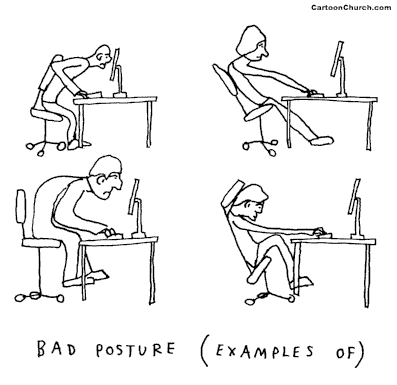
Postural: poor posture causes some muscles to work harder than others. For example, in all the pictures on the left, the neck is forwards shortening the muscles at the front of the neck (flexors) and lengthening the muscles at the back of the neck (extensors). Over time, the flexors will become shorter and tighter while the extensors will be longer and weaker. In time it would be easy to strain the flexors by reversing out of a drive and suddenly turning the neck to look behind you.


Emotional: This one stumps many! Your state of mind is reflected in your body. If you are worried about exams, stressed about a work or facing a relationship break up, your body will "protect" you. Rounded shoulders can be seen as protecting a broken heart. Breathing patterns often change with stress. Normal, unforced breathing uses the diaphragm and intercostal muscles (between the ribs) where as laboured breathing during times of stress or overexhertion overuses the accessory muscles:sternocleidomastoid and the scalene muscles (neck flexors) as they attach the top ribs and the pectoralis minor (deep chest muscle).

Structural; muscle tissue changes in texture and tone that leads to an unhealthy build up of scar tissue which will have a negative effect on physical well-being (shortened muscles).

Scar tissue is formed naturally when tissue is damaged ( strained muscle) from poor posture or over-use. The muscle fibres tear and blood congeals at the wound and collagen fibres are laid down as part of the healing process. If this continues over a long period of time, and is left untreated, it becomes a chronic condition as the scar tissue builds up and then hardens. When muscle fibres “stick” together, the muscle struggles to contract or stretch as fibres need to be able to glide smoothly alongside each other. This affects muscle strength and flexibility. Deep friction (massage technique) breaks down scar tissue into small enough particles to be carried away in the lymph vessels, restoring muscle health.

Hopefully i still have your attention and have not completely lost you with the jargon! Prevention is the key together with listening to your body. If anyone you know has aches and pains after gardening, please send them my way.

Vanessa Mansergh T: 01491 577480 E: info@completeworxmassage.co.uk
For those of you planning on running a Marathon this year or even at the end of the month - this article will be a useful read.

Spring is one of those seasons that makes you realise you have survived Winter reasonably in tact and can now launch yourself into all those activities you had no desire to do in the snow, cold or rain. Gym going is handy but you cannot beat being in the outdoors, the fresh air, lambs and good old english countryside. For cyclists whizzing past - it seems all too idyllic - until "thud" you have been knocked off your bike. How many times does this happen?? One work colleague who is a triathlete and has to train for hours on his bike has witnessed this twice in the last month. Unlucky. He now has an injury unrelated to these incidents ..a partial rupture of his achilles tendon which basically means he cannot train for the next 6 weeks or race.

This is probably the worst possible outcome for anyone -whether you are an athlete or not to have to pull out of a race is soul destroying. You have trained for it, you have psyched yourself up for it, you have endured the pain of it and now you cannot be part of it. Any Marathon runners - take heed from this and make sure you prevent this from happening.

Some facts: according to Sports Medicine Australia, 1/17 sports people suffer a sports injury playing their favourite sport. Perhaps no surprises there. But the interesting fact is that up to 50% of these injuries may have been prevented.

Top Tips to Prevent Sports Injury:

Why Warm-up?
  • Prepares body and mind for more strenuous exercise

  • Increases body's core temperature

  • Increases body muscle temperature making them looser, and suppler

  • Increases heart & respiratory rate which means more blood pumping around body and therefore more oxygen and nutrients to the working muscles
Warm-up Structure - ALL 3 PARTS MATTER
General Warm up:
  • 5-10mins and a light sweat to elevate heart rate and muscle temperature so stretching is more effective now the muscles are warm.
Static Stretching:
  • Safe and effective after the warm up.

  • 5-10mins of main muscles groups ina relaxed way by breathing into the stretch and not forcing it. Hold each stretch for 15 secs.

  • This helps to lengthen muscles and tendons allowing for greater range of movement at joints and to prevent muscle/tendon injuries.
Sport Specific warm-up:
  • More rigorous activities such as football drills.
Cool-down
This is just as important as the warm up for staying injury free.
  • Why?
    Promotes recovery and returns the body to how it was before exercising. During strenuous exercise, muscle fibres, tendons and ligaments get damaged and waste products build up.

  • Helps with post-exercise muscle soreness - usually felt the day after exercise when walking downstairs is barely possible and you get "stuck" in a seat when working or driving. Not pleasant!
Post-exercise muscle soreness happens because exercise causes tiny micro -ears in the muscle fibres. These cause the muscle tissues to swell which put pressure on nerve endings causing pain. During exercise the heart pumps lots of blood to the working muscles bringing with it oxygen and nutrients. Once used the blood is pumped back to the heart through the muscles contracting. Once you stop exercising this force stops and blood, and waste products of exercise like lactic acid pool in the muscle causing swelling and pain.

Cool-down Structure
Gentle Exercise
  • 1 0-15mins (professional) or 3-5mins (amateur) of easy exercise that ressembles the type of exercise you were doing eg.jogging if you were running
Stretching
  • 20-30mins (PRO) or 5-10mins (AM)
Re-fuel
  • Drink plenty of water & a good quality sports drink & something to eat like fruit which is easily digestable.

Sports Massage has the same effect on the muscles in the cool down section - in that it prevents that post-exercise muscle soreness. If you would like to book an appointment, please contact Vanessa on 01491 577480 or 07906186912.